
Teen Patti Casino Games in India

Types of Teen Patti Games in India
Teen Patti (also called Indian Flush or 3 Patti) is played in many formats across India, from classic “blind/seen” tables to modern live-dealer versions with side bets.
Each type keeps the same core idea: build the best three-card hand (or make others fold) and win the pot through smart betting, observation, and timely shows.
Below are popular Teen Patti game types you’ll commonly find on Indian tables and online apps, along with quick summaries of how each format works.

Classic Teen Patti (Blind/Seen)
This is the traditional Teen Patti format played at gatherings and on most apps: everyone antes into the boot, gets three face-down cards, and plays clockwise.
Players choose to play Blind (without seeing cards) or Seen (after viewing cards). Blind bets are smaller, while Seen players usually bet at least double.
The round ends when all but one player folds, or when only two remain and a Show is called to compare hands.
Common actions include Chaal (call), Raise, Pack (fold), Sideshow (private comparison request), and Show (final reveal with two players left).
| Feature | Blind | Seen |
|---|---|---|
| Cards visible | Not seen (face down) | Seen (checked privately) |
| Typical minimum bet | At least the current stake/boot rule | Usually 2× the current stake |
| Show eligibility | Allowed when only two players remain | Allowed when only two players remain |
| Sideshow | Usually not allowed unless rules permit | Can request the previous player (may accept/reject) |
| Best way to use | Bluff, control risk, build pressure slowly | Value-bet strong hands, time sideshows carefully |
Joker Teen Patti
Joker Teen Patti adds a wild-card twist. A joker (or a designated rank/suit) can substitute for any card, making strong hands appear more often.
Rules vary by table: some use a printed joker, while others reveal one “joker card” from the deck and treat all cards of that rank as jokers.
Because jokers increase hand strength, games tend to be faster, with more big raises and more frequent shows.
| Variant | How the joker is chosen | What becomes wild | Gameplay impact |
|---|---|---|---|
| Printed Joker | One or more physical joker cards are included | The joker card(s) | More high hands; bluffing becomes riskier |
| Open Joker | One card is revealed from the deck | All cards of that rank | Boosts combinations like trails and sequences |
| Suit Joker | A suit is pre-decided (house/table rule) | Specific suit cards as wild (rule-based) | Encourages aggressive betting and quicker shows |
| Two Joker | Two cards/ranks are designated as wild | Two wild ranks/cards | Very swingy; big pots are common |
| Dealer Joker | Dealer reveals a joker after the deal | Declared rank becomes wild | Creates sudden shifts in odds mid-hand |
Muflis (Lowball Teen Patti)
Muflis flips the usual Teen Patti ranking: the lowest hand wins instead of the highest, so weak-looking cards can become powerful.
This variant is popular online because it changes bluffing dynamics—players must “think in reverse” when deciding whether to stay in.
Before playing, confirm how your table defines “low” (some rooms treat A as low, while others keep Ace high).
| Rule element | Classic Teen Patti | Muflis | What to watch for |
|---|---|---|---|
| Winning objective | Highest three-card hand wins | Lowest three-card hand wins | Hands you’d fold in classic may be premium here |
| Bluffing pattern | Represent strength | Represent weakness (or confuse opponents) | Bet sizing tells can invert |
| Show strategy | Show with strong hands | Show with “weak” hands | Confirm table’s Ace and sequence rules |
AK47 Teen Patti
AK47 is a fun Indian Teen Patti variation where A, K, 4, and 7 are treated as jokers (wild cards) for all players.
With four ranks acting as wild, high combinations form frequently, so rounds are action-heavy and pots can grow quickly.
This format rewards timing: because many players can make strong hands, choosing the right moment to raise or call a show matters even more.
| Element | Standard rule | AK47 rule | Result |
|---|---|---|---|
| Wild cards | None (unless specified) | A, K, 4, 7 are wild | More trails, sequences, and strong pairs |
| Hand strength spread | Wide; many weak hands | Narrower; many playable hands | More calls, fewer early packs |
| Ideal approach | Selective aggression | Controlled aggression | Don’t overvalue medium hands |
Best of Four (4-Card Teen Patti)
In Best of Four, each player receives four cards and must choose the best three-card combination from those four to form their final hand.
This small change increases decision-making and reduces pure luck, because you can “discard” your weakest card and optimise your best trio.
Best of Four is a great choice for players who enjoy hand selection and calculated play rather than only betting pressure.
| Aspect | Classic Teen Patti | Best of Four | Why it matters |
|---|---|---|---|
| Cards dealt | 3 per player | 4 per player | More possibilities per hand |
| Hand formed | All 3 cards count | Choose best 3 of 4 | Better control over outcomes |
| Strategy focus | Reading + betting pressure | Reading + selection + betting | More “skill feel” in close spots |
Live Dealer Teen Patti (Casino-Style)
Live Dealer Teen Patti is a casino-style format where you play against the dealer/house rather than a circle of players, often with an Ante + Play structure and optional side bets.
Rules can include dealer qualification (for example, “Queen High or better”) and separate payouts for side bets such as Pair Plus or 6 Card Bonus.
| Bet type | What it depends on | How it’s decided | Typical outcome |
|---|---|---|---|
| Ante | Main game entry bet | Placed before cards are dealt | May pay if you beat the dealer |
| Play | Your decision after seeing cards | Match the Ante to continue, or fold | Usually wins/loses with the main comparison |
| Pair Plus | Your 3-card hand only | Pays if you have a Pair or better (table rules apply) | Independent payout, separate from main game |
Slots
 Roulette 3
 Respin Joker 1000
 Rabid Randy Gone Fishing
 2 Burning Baseballs
 Zeus Ultim8 Pays
 Arcanum
 Gold Trio: Leprechaun’s Luck Race Bonanza
 K Yeti Gold
 Love Show
Live Casino
 Ozwin's Jackpots
 Caribbean Stud Poker
 Super Multitimes Progressive
 Kingdoms Rise: Sands of Fury
 Kingdoms Rise: Captain's Treasure Jackpot
 Kingdoms Rise: Forbidden Forest
 Kingdoms Rise: Reign of Ice
 Kingdoms Rise: Guardians of the Abyss
 0p Roulette
How to Play Teen Patti (Indian Flush)
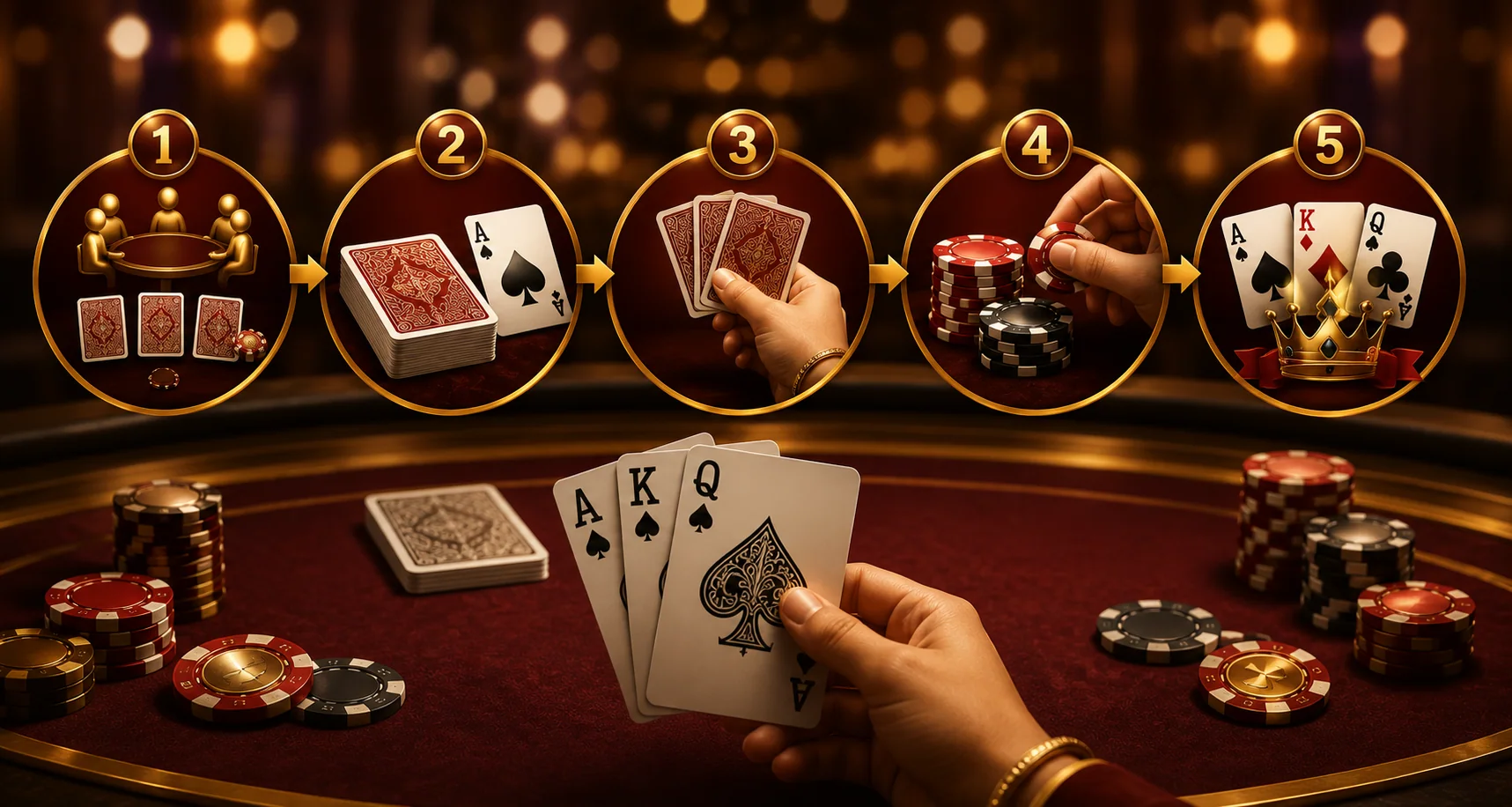
Teen Patti is a classic Indian card game played with a standard 52-card deck. The aim is to make the best three-card hand and win the pot, either by having the highest-ranking combination at Show or by getting other players to fold through smart betting.
- Step 1: Place the boot (initial bet) into the pot before any cards are dealt. Step 2: The dealer deals three cards to each player, one at a time, face down.
- Step 3: Choose how to play: stay Blind (bet without seeing your cards) or turn Seen (look at your cards). Blind bets are usually the minimum stake; Seen bets are typically at least 2× the minimum.
- Step 4: Bet, call (chaal), raise, or fold (pack) in clockwise order. If you started Blind, you can switch to Seen in a later round by looking at your cards and continuing as a Seen player.
- Finish the round: The hand ends when only one player remains (everyone else folds) or when two players are left and one calls for a Show. Both reveal cards, the higher-ranking Teen Patti hand wins the pot; if there’s a tie, the player who called the Show loses.
How to Deposit to Play Teen Patti in India
Use this quick cashier guide to add funds and join Teen Patti tables in India. Choose a payment method you trust (UPI is usually the fastest), enter the amount, confirm the payment, and wait for the balance to update before you place your boot (ante).
- Step 1: Select Deposit in the Cashier and choose a payment method (UPI, NetBanking, card, or e-wallet, if available).
- Step 2: Enter your deposit amount in INR and double-check any minimum/maximum limits shown in the cashier.
- Step 3: Complete verification/confirmation (UPI collect request or QR scan; for cards, enter OTP if prompted) and approve the payment.
- Step 4: Return to the lobby, confirm your updated balance, then open Teen Patti and choose a table that matches your bankroll and preferred stakes.

Teen Patti (Indian Flush) in India: FAQs
Teen Patti (also called 3 Patti or Indian Flush) is a popular three-card game played with a standard 52-card deck. Each player receives three cards, and the aim is to win the pot by either making the highest-ranking three-card hand at the Show or by getting other players to fold through smart betting and bluffing.
“Blind” means you play without looking at your cards (they stay face down), and you generally bet the minimum stake. “Seen” means you have looked at your cards, and you typically must bet at least 2x the minimum stake. If you start Blind, you can choose to become Seen in a later round by viewing your cards.
The highest hand in Teen Patti is a Trail/Trio (three of a kind), such as A-A-A. Next comes a Pure Sequence (Straight Flush), followed by Sequence (Straight), Color (Flush), Pair, and finally High Card (lowest).